Explore the Mysterious Alleys of Old Amman
 The Experience
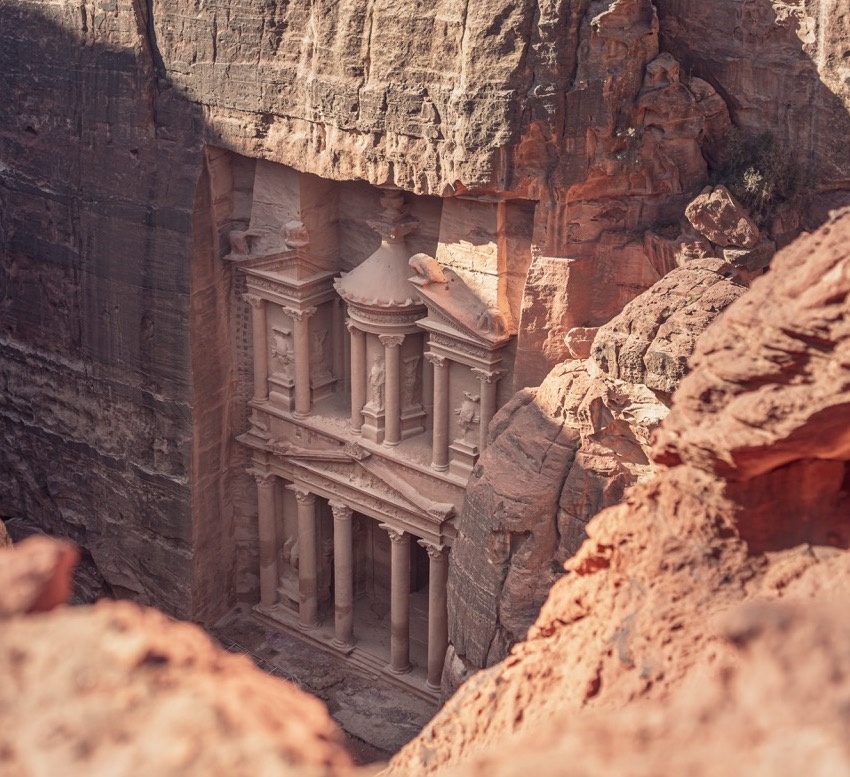
Terraced into the dry ravines of seven geological ridges, Amman is defined by its quarried yellow and cream limestone, a material mandated across every facade. The urban fabric descends via steep public staircases—the stone adraj—connecting the upper crests of Jabal Amman and Jabal al-Weibdeh to the floor of the ancient Seil valley. Along these passages, early twentieth-century domestic masonry, characterized by triple-arched windows and cast-iron balustrades, sits alongside bedrock foundations dating to the Iron Age Ammonite kingdom.
The ascent reaches the plateau of Jabal al-Qal’a, site of the ancient Citadel. Here, the surviving shafts of the second-century Roman Temple of Hercules rise directly out of the exposed limestone strata, their weathered stone drums reflecting late daylight across the steep urban bowl below. Behind the perimeter of the Roman ruins, the cut-stone courtyard and cruciform vestibule of the eighth-century Umayyad Palace illustrate early Islamic hydraulic and defensive engineering—a study in raw bedrock foundations, terraced urban geology, and continuous Levantine masonry.
Location & Clearance
Jabal al-Qal’a Citadel & Jabal Amman Historic Quarter · Amman, Hashemite Kingdom of Jordan
Private Citadel Enclosure Clearance · Department of Antiquities Archaeologist Escort · Restricted Heritage Zone Access


Add This Experience to Your Journey
Tell us your dates and we'll weave this into your bespoke itinerary.