Decode the Silk Road Soul of the Uzbek Cauldron
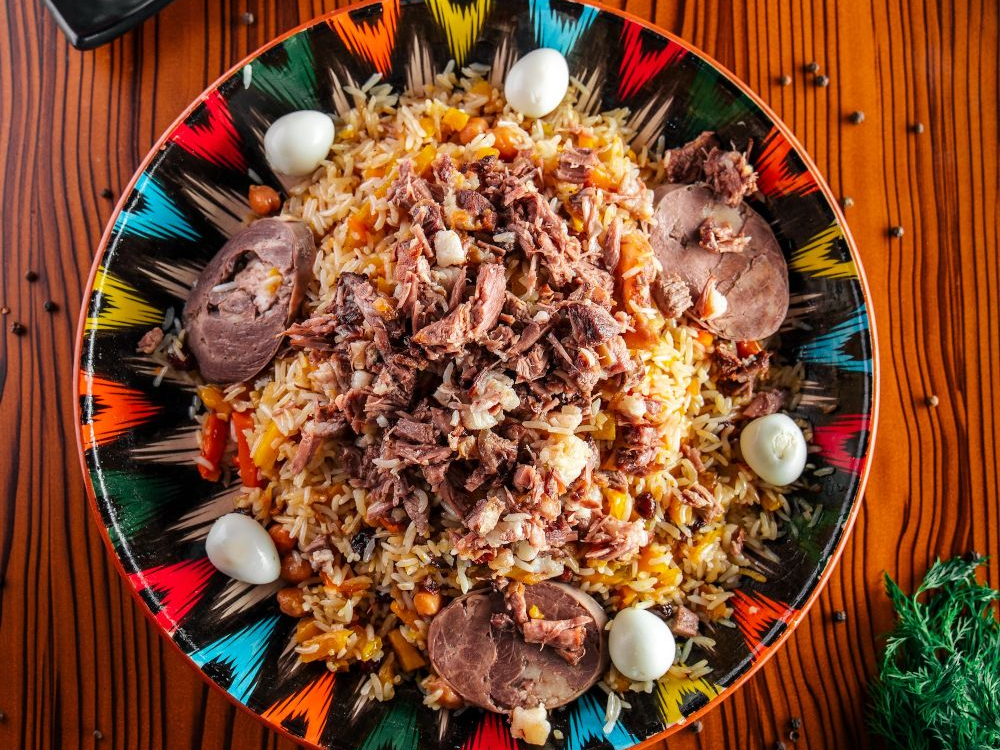 The Experience
Across the stone courtyards of Samarkand and the historic quarters of Tashkent, cooking centers entirely on the qozon—a spherical, thick-walled cast-iron cauldron set over wood-fired brick hearths. Preparation of traditional Uzbek osh relies on strict stratification rather than stirring. Fat rendered from the dumba tail-fat sheep of the Kyzylkum steppe browns chunks of pasture-fed mutton, layered with matchstick-cut yellow carrots and whole heads of unpeeled garlic to form the zirvak—the concentrated liquid foundation seasoned with crushed wild mountain cumin and dried barberries.
The procedure transitions from open boiling to controlled vapor retention. Washed long-grain devzira or lazgi rice, rinsed until free of surface starch, is mounded atop the meat and vegetable strata, pierced with wooden dowels to form steam chimneys, and sealed under a heavy ceramic lid. In a private cooking enclosure closed to public gatherings, the oshpaz monitors sub-surface evaporation, thermal retention in the iron curvature, and individual grain firmness. Served directly onto hand-painted Rishtan ceramic platters, the meal remains an unvarnished examination of Central Asian pastoral butchery, heirloom grains, and medieval cauldron thermodynamics.
Location & Clearance
Chorsu Historic Quarter & Private Hearth Compound · Tashkent & Samarkand
Private Guild Kitchen Clearance · Master Oshpaz & Central Asian Food Historian Escort · Restricted Hearth Enclosure Access


Add This Experience to Your Journey
Tell us your dates and we'll weave this into your bespoke itinerary.