Explore the Hidden Palaces of the Tunis Medina
 The Experience
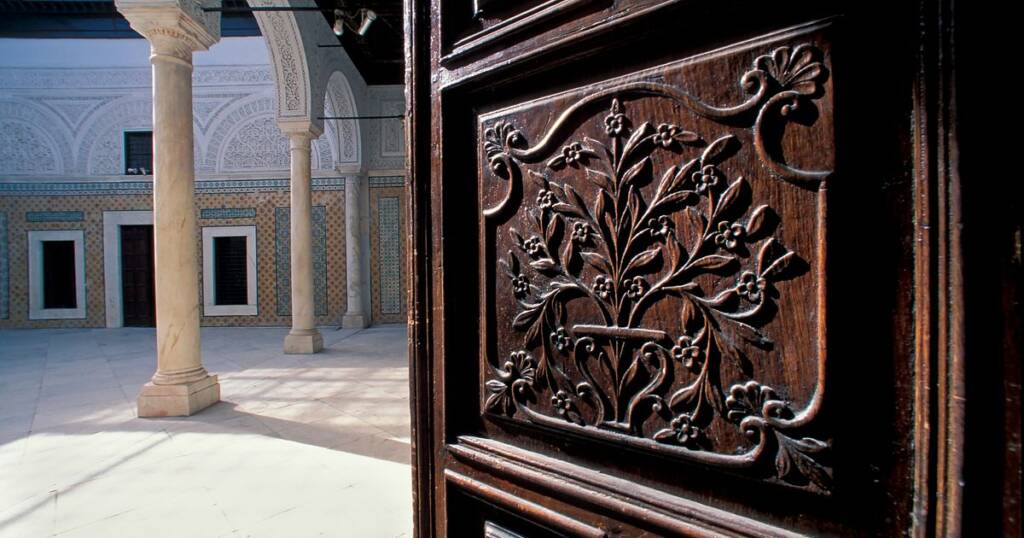
Concealed behind blind whitewashed facades and studded cedar doors, the Medina of Tunis preserves an urban grid structured during the Hafsid dynasty. At its core stands the eighth-century Zitouna Mosque, an interior hypostyle hall supported by one hundred and sixty ancient granite and porphyry columns reclaimed directly from the ruins of Roman Carthage. The surrounding arteries narrow into vaulted stone alleys engineered to deflect Mediterranean heat, opening into central domestic courtyards lined with white Carrara marble and geometric polychrome earthenware.
The route accesses private residences such as Dar Lasram, documenting the convergence of Ottoman and Andalusian building methods. Thick load-bearing masonry supports hand-chiseled naqsh hadida plasterwork, carved wet in geometric and calligraphic friezes beneath beams of Lebanon cedar painted with natural mineral pigments. At ground level, the quiet of blind dead-ends gives way to the vaulted corridors of the Souk el-Attarine, where distillation of bitter orange flower and sandalwood oils follows centuries-old brass alembic practices—a measured encounter with medieval North African urbanism, spolia architecture, and sovereign masonry.
Location & Clearance
Zitouna Enclave & Palatial District · Medina of Tunis UNESCO Old City
Private Hafsid Palace Archive Clearance · National Heritage Institute Historian Escort · Restricted Historic Derb Access

Add This Experience to Your Journey
Tell us your dates and we'll weave this into your bespoke itinerary.